
Coveo reindex error: The parameter 'p_Communication' must not be null

I was getting the following error when try to re-index Coveo in a new environment.
The parameter 'p_Communication' must not be null

This was fixed by setting the Sitecore username/password needed for communication between Coveo and Sitecore. You can do this by going to the Control panel in Sitecore. Under the Coveo search section, click on "Configuration" and then the "Configure" button under the Sitecore Credentials heading.
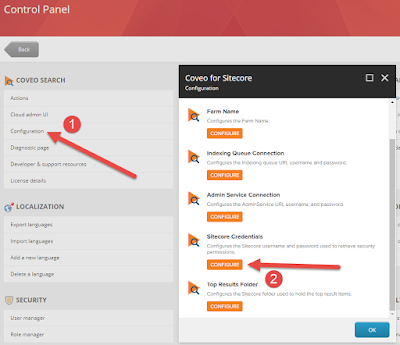
Coveo reindex communication error

This is not an issue in a lower environment like your local since Coveo uses the default admin b password to authenticate. But this becomes an issue in any higher environment that doesn't use the default admin password. Hope this helps someone else. 


Comments

Popular posts from this blog

Adding Entra ID Auth to a Blazor App

I wanted to take the time to write up this article since I found it useful when working on Blazor Apps. Althought this is not Sitecore related, I think it will be useful if we need to build an admin .NET portal. Additionally most organizations already have Entra ID if they use Microsoft apps and building Entra ID Authentication wont add costs like other Authentication methods would. To get started make sure the following packages are available (using NuGet) in your solution. Microsoft.Identity.Web Microsoft.Identity.Web.UI Azure.Security In your Program.cs file, add the following using Microsoft.AspNetCore.Authentication.OpenIdConnect; using Microsoft.Identity.Web; using Microsoft.Identity.Web.UI; // Add Microsoft Entra ID authentication builder.Services.AddAuthentication(OpenIdConnectDefaults.AuthenticationScheme) .AddMicrosoftIdentityWebApp(builder.Configuration.GetSection("AzureAd")); builder.Services.AddAuthorization(options => { options.FallbackPo...

Back-End and Front-End Development in Sitecore XM Cloud

  Understanding the Roles In Sitecore XM Cloud, back-end developers primarily manage content models, custom APIs, and data within the Sitecore CMS backend. On the other hand, front-end developers focus on building the user interface and interactions using a JavaScript framework like React, consuming content from the backend via GraphQL endpoints. The headless CMS architecture of Sitecore XM Cloud allows the front-end to be largely decoupled from the back-end, providing flexibility in technology choices and development workflows. Back-End Developer Responsibilities Back-end developers in Sitecore XM Cloud are responsible for: Deployment of all custom components to XM Cloud. Synchronizing components, code, and content between Prod and Non-Prod environments. Answering questions from content authors regarding component usage, troubleshooting site load, caching, and component versions. Troubleshooting Edge CDN issues related to content updates. Designing and managing content structures,...

Sitecore XM Cloud local development setup

Below are my notes when setting up a local Sitecore XM Cloud development environment. There are many good blog articles for local XM setup but the following 3 were the most useful for me Blog 1 - Used for Docker setup Blog 2 - Used for Rendering site setup Blog 3 - Used to install test content in local CM Using the information from the first 2 articles I was able to setup my local docker environment by running the up.ps1 script and then having a local Sitecore instance running on https://xmcloudcm.localhost I also had my local next js rendering site running using start:connected and accessed using the url http://localhost:3000 You can write all your rendering React code in your React app. You can create components using Json renderings in Sitecore and have corresponding tsx files in the components folder of your React app. For any Sitecore content items that are part of the component, you serialize those items as yml files in your codebase. ...